Do You Need to Vent an Electric Fireplace?
No, you do not need to vent an electric fireplace. It burns nothing, so it produces no smoke, carbon monoxide or exhaust that has to go outside, which is why it can sit flat against a wall or drop into a recessed opening.
On this page (9 sections)
- Why an electric fireplace needs no vent at all
- Does an electric fireplace give off any fumes or smoke?
- What do the grilles and air vents on an electric fireplace do?
- Where can you install a unit with no flue?
- How do you plan the wall or opening instead of a flue?
- Does venting change how an electric fireplace heats a room?
- How much power does a vent-free fireplace use?
- What safety checks replace a vent inspection?
- So do you need to vent an electric fireplace before you buy?
No, you do not need to vent an electric fireplace. It burns nothing, so it makes no smoke, carbon monoxide or exhaust that has to go outside.
The unit is a light display with an optional fan heater, and it runs on a standard outlet. There is no chimney, flue or outside air duct in the plan, which changes where you can put one.
Why an electric fireplace needs no vent at all
An electric fireplace needs no vent because there is no fire and no fuel. A wood or gas fireplace creates smoke and gases that must leave the house; an electric model creates light and, when switched on, warm air moved by a fan.
That difference decides the install. You do not cut a hole through an exterior wall, add a chimney liner or a fresh-air intake, or lose heat up a flue while the room cools.
The flames you see are an LED and light pattern behind a screen. Nothing is burning, so the only thing that leaves the unit is warm air from the heater grille, and that air stays indoors.
This is why an electric fireplace can be judged on looks and warmth alone. A gas insert ties you to a flue path and a masonry or framed chimney chase, while an electric one asks only for a framed opening or a bracket on the wall, plus power.
Does an electric fireplace give off any fumes or smoke?
It gives off no smoke and no fumes. With no combustion, there is no carbon monoxide and no smell of burning wood or gas, so the room does not need a flue to clear it.
That is the main reason electric fireplaces work in apartments, basements and interior rooms with no outside wall. A gas unit in the same spot would need proper venting and a professional install.
A faint hot-dust smell can show up when a new heater runs for the first time. It fades after a short session, and it is not the same as exhaust; there is nothing toxic being carried away.
The smell comes from dust settling on the heating element, not from fuel. If a smell lingers past the first few uses, wipe the grille and the housing, because there is no vent to block.
What do the grilles and air vents on an electric fireplace do?
The grilles are air openings for the heater, not an exhaust. A fan pulls room air in, warms it across a heating element and pushes it back into the room, and the slit you see is where it moves.
This trips people up because gas and wood units use similar-looking vents for exhaust. On an electric model the air simply loops inside the room: nothing is piped away, and nothing needs to go outside.
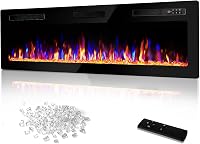
Unineo designs its 50 Inch Hidden-Vent Fireplace around this idea. The slanted front panel hides the air openings almost out of view, which keeps the frame looking clean while the heater still moves air.
The name says it well: hidden vents, not ventless exhaust. The air openings are there for warmth, and the design tucks them where the eye does not land.
Where can you install a unit with no flue?
You can install it on any wall with power, inside or out of reach of an outside wall. An interior partition, a basement wall, an apartment living room and a bedroom all work, because nothing has to connect to the sky.
Recessed models drop into a framed opening and wall mounted models hang on brackets. A wall unit like the Unineo is built for both routes and comes with a wall mount bracket in the box.
Several styles suit the no-vent setup. A 3 sided electric fireplace shows flame from more than one angle on a feature wall.
A linear electric fireplace runs long and low across a wide wall, and a thin electric fireplace saves depth where the wall is shallow.
Depth is the one number that changes with the model. A shallow wall may not take a deep firebox, so check the recessed size before you frame.
How do you plan the wall or opening instead of a flue?
Plan framing, power and clearance, not ductwork. Check that the spot has an outlet or a way to add one, then confirm the opening size and the cord route before you cut.
An insert model needs a finished opening and often a trim to close the gap. Our guide to the electric fireplace insert trim kit explains how that frame finishes the job.
For a hung unit, find the studs so the bracket bites solid wood. The DEWALT Stud Finder locates stud centers for wood and metal with a 3/4 in. depth, and it flags live wires in the wall for safety.
The finder runs on constant auto-calibration, which saves the manual reset step some older models ask for. It marks the center of the stud through a channel on the body, and an audible alert plus directional arrows tell you when you are on target.
Its limits matter too. DEWALT says the sensor will not read through concrete, brick, plaster, foil-faced materials or ceramic tile, so plan the bracket by another method on those walls.
Measure the wall, mark the bracket holes and check the cord will reach the outlet without an extension lead running across the floor.
Does venting change how an electric fireplace heats a room?
No flue means no heat lost up a chimney, so more of the warmth the heater makes stays in the room with you. The catch is that it is a room warmer, not a whole-home furnace.
A gas or wood fireplace sends part of its heat up the flue. An electric heater delivers its warmth straight into the air, so the room warms quickly near the unit and cools as you move away.
Unineo says its heater helps warm a cool room but is not a primary heat source. Use it for a den, bedroom or finished basement where you want local warmth, and keep the main heating system for the rest of the house.
The Unineo uses an infrared heater rated 1500W on a 120V, 60Hz circuit that needs a 15 amp breaker. That fits a standard household circuit, and it also tells you not to stack the fireplace on the same circuit as a space heater or a kettle.
How much power does a vent-free fireplace use?
It runs on household electricity, and that cost is the number worth checking. The heater draws the most; flame-only mode draws very little because only the light and controls are on.
A power monitor plugs in between the outlet and the fireplace and counts kilowatt-hours. The P3 Kill A Watt has four settings and shows usage by day, week, month or year, and it figures the cost over the same periods.
The monitor handles up to 15 A, which matches the fireplace's circuit, and it is built for AC 115-volt appliances. It also shows voltage, line frequency and power factor, so you can see whether the outlet is holding steady under load.
Pick the setting that fits your habit. A week of evening use is easier to read than a single hour, and the yearly view gives you a bill-shaped number to compare against the rest of the house.
Run the fireplace on heat for a normal evening and read the result. That tells you more about your bill than a guess from the heater's rating alone.
What safety checks replace a vent inspection?
With no vent, your checks are power, clearance and heat, not a flue sweep. Keep the cord and plug in good shape, and keep the grille clear of curtains, bedding and furniture.
Follow the clearance the maker sets. Unineo asks for 8 inches between its fireplace and a TV, so warm air rising from the top does not collect against the screen.
The Unineo can also run flame-only with the heat off, which lets you enjoy the look on a warm evening without adding warmth. Use the child lock and timer on the remote if young children are around.
Its remote shows every function, from the flame and ember colors to the thermostat and child lock, so you are not guessing which setting is on. Clean the grille and front glass so airflow stays open, and check that the outlet circuit is not shared with heavy appliances.
If the cord or plug feels hot, stop using the unit and have an electrician look at the circuit.
So do you need to vent an electric fireplace before you buy?
No. **Do you need to vent an electric fireplace?
The answer is no for every model**, because there is no fire to exhaust.
Buy for the wall, the style and the power, and skip the flue planning entirely.
Pick a recessed model if you can frame an opening, or a wall hung unit if you would rather not cut. Check the outlet, find the studs and leave the clearance the maker asks for around the heater.
If you want the flame without the heat, look for a unit that runs flame-only. That is the real advantage of the vent-free design: the room gets the look on your terms, and the heater is there when you want it.
Frequently asked questions
Do you need to vent an electric fireplace?
No. An electric fireplace has no combustion, so there is nothing to send up a chimney or out through a wall.
It only needs its power cord plugged into a working outlet, and the flame image runs on light, not fire.
Can an electric fireplace go into a spot with no chimney or flue?
Yes, that is normal. It works in a basement room, an apartment wall or an interior partition with no outside wall.
You do not add a flue, and you do not lose heat up a chimney.
Does an electric fireplace make the room stuffy?
Not from fumes, because it makes none. Some units run a small fan to push warm air out, which can feel drying over long sessions, so crack a door or lower the thermostat if the air feels stale.
Why do some electric fireplaces have vents or grilles on them?
Those are air openings for the heater. A fan pulls room air in, warms it over a heating element and blows it back out.
They move air inside the room; they are not an exhaust route to the outdoors.
Can I put an electric fireplace under a TV or on a shelf?
Usually yes, since there is no exhaust. Keep the heat clear of anything above it; Unineo asks for 8 inches of space between its fireplace and a TV so rising warm air does not sit against the screen.
Is a ventless electric fireplace safe in a bedroom?
Electric models are common in bedrooms because there is no flame and no exhaust gas. Give the heater room to breathe and keep bedding and curtains clear of the grille.
A working smoke alarm on each level is still the baseline for any home.