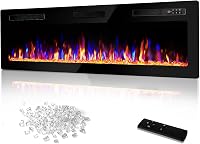
What Is an Electric Fireplace?
An electric fireplace is a ventless heating and flame unit that runs on a standard 120V outlet and needs no chimney, gas line or venting. You can run the flames alone for ambiance or turn on the heater for supplemental warmth.
On this page (10 sections)
- How does an electric fireplace actually work?
- What makes it different from a wood or gas fireplace?
- Where can you install one?
- How much heat does an electric fireplace produce?
- What should you know before you buy?
- Can you use it without heat?
- How much does it cost to run?
- Is an electric fireplace safe?
- Which type fits your room?
- The short version
An electric fireplace is a ventless heating and flame unit that runs on a standard 120V outlet and needs no chimney, gas line or venting. You can run the flames alone for ambiance or turn on the heater for supplemental warmth.
That combination is the reason people ask what is an electric fireplace in the first place: it looks like a fire, plugs in like an appliance, and gives you warmth without a real flame. Here's how it works and what to expect.
How does an electric fireplace actually work?
It produces flame effects with LED lights and heat with an electric element, all inside one cabinet. The flames are a light display behind glass, and the heater is a separate fan-driven element.
A typical unit has two jobs. The flame effect uses low-power LEDs to mimic logs and embers.
The heater draws more current and blows warm air into the room.
Because the two systems are separate, you can run either one alone. That's why an electric fireplace is often described as year-round: glow in summer, heat in winter.
A recessed model like the Touchstone Forte also lets you choose logs, crystals or both for the hearth look.
The heater side is a fan pushing air past a heating element, which is why these units warm a room quickly rather than slowly radiating heat like masonry. The duraflame log set uses a quartz element, and the Forte uses an electric element rated at 5,100 BTU.
Neither creates a real flame, so there's nothing to feed.
What makes it different from a wood or gas fireplace?
There's no real combustion, so there's no chimney, vent or gas line. That changes installation, maintenance and safety in ways that matter before you buy.
A wood fireplace needs a flue and regular chimney cleaning. Gas needs a supply line, a vent and a professional install.
An electric unit needs an outlet and, in most cases, a spot to recess or mount it.
There's also no smoke, soot or ash. The unit stays cool on the sides and back when the heat is on, which is why manufacturers allow mounting under a TV with clearance.
Check your model's clearance; Touchstone recommends 8 inches between the Forte and a TV.
Maintenance is mostly dusting the glass and the ember bed. There are no gaskets, logs to replace or flue to sweep.
The Forte carries a one-year limited warranty from Touchstone.
Where can you install one?
You can put an electric fireplace in a wall, in an existing fireplace opening, or as a wall-mounted unit, as long as there's power nearby. No venting means far more placement options than gas or wood.
Common spots include a living room feature wall, a bedroom, a basement rec room or a covered porch with an outlet. The Touchstone Forte is built for recessed in-wall mounting and can also go into an unused fireplace opening.
If you don't want to cut drywall, look at a log set that drops into an existing hearth. Thin wall-mounted models suit small rooms where depth is tight.
For a modern look, a linear electric fireplace spans a wall without taking floor space.
Space matters on the power side too. The Forte comes with a 6-foot cord for a 110-120V outlet, so the outlet needs to be close enough or the unit hardwired.
A log set needs only a reachable outlet inside or near the hearth.
How much heat does an electric fireplace produce?
Most portable units put out supplemental heat in the range of 4,600 to 5,100 BTU, enough to warm a room up to about 400 sq ft. That's zone heating, not whole-home heat.
The Touchstone Forte is rated at 5,100 BTU and covers up to 400 sq ft. The duraflame log set is rated at 4,600 BTU for the same 400 sq ft.
Both are meant to take the edge off a cool room.
That's the honest limit of an electric fireplace. It won't replace a furnace or boiler.
It will keep a den, bedroom or basement comfortable without heating the rest of the house. Many units include a thermostat and a shut-off timer so the heater doesn't run longer than you need.
The Forte's thermostat ranges from 68 to 88 degrees, with two heat settings and a shut-off timer you can set for 1 to 8 hours. The duraflame log set has an adjustable thermostat plus separate flame speed and brightness controls on the remote.
What should you know before you buy?
Match the unit to your opening, your outlet and your goals. The three things that trip people up are size, power draw and whether they want heat at all.
First, measure the opening. The Forte needs a chamber about 39.25 inches wide and 28 inches high, with 5.5 inches of depth.
Recessing a unit that's too big means rework.
Second, check the circuit. The Forte draws a max of 12 amps, so it can run on a 15-amp circuit.
A 20-amp circuit may be needed if other electronics share that circuit.
Third, decide on the look. A 3 sided electric fireplace shows flames from more than one angle and suits a feature wall.
A thin electric fireplace fits where depth is limited. For a broader comparison of models, see what are the best electric fireplaces.
Do you need to recess it or can it mount on the wall?
Both routes exist, and the Forte handles either one. Recessed means the unit sits inside the wall cavity for a flush face.
If you don't want to open the wall, the Forte includes a wall-mount bracket so it can hang like a picture with its frame proud of the surface.
A log set takes a third path. It isn't mounted at all.
You place it inside an existing hearth, which is why duraflame calls it an insert and why it needs no construction.
Can you use it without heat?
Yes, flame-only mode is common, so you can enjoy the glow in summer without warming the room. Independent flame and heat controls are the feature to look for.
The duraflame log set is built this way: it has separate flame and heat controls, so you can run the lifelike flames year-round. The Forte also runs with no heat when you just want ambiance.
This matters for small rooms and warm climates. A unit with only combined controls heats whenever the flames are on, which is less useful in July than in January.
How much does it cost to run?
Running cost depends on your electricity rate and how long the heater runs. Flame-only mode uses very little power; heating mode is the bigger draw.
A plug-in power monitor takes the guesswork out. The P3 Kill A Watt counts consumption in kilowatt-hours by day, week, month or year and calculates the cost.
Plug the fireplace into it and you'll see exactly what it uses.
That's useful if you're deciding between running the heater or leaving it off. It's also a simple way to compare one unit against another in your own home.
For more on choosing between models, the best electric fireplaces guide covers the trade-offs.
Is an electric fireplace safe?
Yes, when installed as directed, an electric fireplace is safe to run without a chimney, and most units stay cool on the sides and back. Safety comes down to following the clearance and circuit rules.
Keep the vents clear and don't run the heater under a shelf or against fabric. Use the thermostat and timer so it shuts off on its own.
Plug it directly into a wall outlet rather than a power strip.
If you're putting a unit into an old fireplace opening, have a licensed professional confirm that unused gas lines and vents are secured. Touchstone says this directly for the Forte.
It's a small step that removes a real risk.
Overheat protection is built into many thermostats, including the Forte's auto-off feature. That's the layer that backs up the timer.
Front-facing heater vents on the Forte are also what let it sit under a flat screen without blowing hot air up the wall.
Which type fits your room?
Pick the style by where it goes and how much wall you want to give it. The right type depends on your room's shape and whether you have an existing hearth.
A recessed wall unit like the Forte suits a feature wall with depth to spare. A log set like the duraflame is the easiest path if you already have a fireplace opening and an outlet.
Thin and linear models suit modern rooms with narrow walls.
For an unused hearth, the duraflame log set needs no vents, gas lines or construction. It comes fully assembled, so you plug it in and place it in the hearth.
Once you've picked a type, check the opening size, the circuit and whether you want smart controls. Those three checks cover most of the decision.
After that, the flame style is mostly taste.
The short version
An electric fireplace is a ventless, plug-in unit that gives you flames with or without heat, and it's best used as supplemental warmth in one room. It won't replace your furnace, but it will make a den, bedroom or basement cozier without a chimney or gas line.
Measure your opening first, check your circuit, and decide whether you want flame-only mode. Then choose a recessed unit for a feature wall, a log set for an existing hearth, or a thin model for a tight space.
If you're still weighing options, the best electric fireplaces guide is the next stop.
Frequently asked questions
Do electric fireplaces give off real heat?
Yes, most include a heater that puts out supplemental warmth, often enough for a room around 400 sq ft. The heater is separate from the flame, so you can run the glow without adding heat in warm months.
Can you run an electric fireplace without heat?
Yes. Flame-only mode is common, so you get the look of a fire in summer without warming the room.
Check that the unit has independent flame and heat controls before you buy.
Do electric fireplaces need a chimney or vent?
No. They're ventless, so there's no flue, chimney or gas line to install.
Most plug into a regular 120V outlet, though some can be hardwired for a cleaner in-wall look.
Can an electric fireplace replace my furnace?
No. It's designed as supplemental heat for a room or zone, not a primary whole-home heat source.
The heater takes the edge off a cool space but won't replace a furnace or boiler.