Can I Use an Electric Fireplace Outdoors?
No. A standard electric fireplace is not built for outdoor use. It needs a dry, covered spot and a grounded indoor-style outlet, and most units are rated for indoor rooms only.
On this page (8 sections)
- Why an electric fireplace isn't an outdoor appliance
- Can you use an electric fireplace outdoors under a roof?
- What power and outlet does a porch install need?
- Which electric fireplace fits a covered patio wall?
- How do you mount one so rain doesn't reach it?
- How much does an outdoor run cost to operate?
- Is an open porch ever the right place for one?
- What should you decide before you buy?
No, you can't safely use a standard electric fireplace outdoors. A typical unit is built for a dry indoor room, and its cord, plug and housing don't hold up to rain, humidity or a damp deck.
That answer covers the unit you see online. What matters next is where it can actually live, what power it needs, and how to mount it so the fire looks right from the porch.
Why an electric fireplace isn't an outdoor appliance
An electric fireplace is a plug-in appliance with no weather rating, so it belongs in a dry, covered space. The heating models draw real current for hours, and the housing and controls are not sealed against rain.
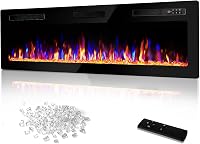
Most of these units are made for a wall cavity inside a house. The Tangkula 36 Inch is a recessed model with a slim 2 in profile, and it's flame only, so it adds glow and no heat.
Its build tells the story: a cold-rolled carbon metal body, a tempered glass front panel and a powder-coated black finish. Those materials are made for a living room wall, not for an exterior one that takes wind-driven rain.
Exposed units face two risks: moisture reaching the electronics and water pooling near the plug. Keep any corded unit out of the weather.
Treat "outdoor" as a marketing word unless the brand states a rating in writing.
Can you use an electric fireplace outdoors under a roof?
You can use one in a covered, dry spot such as a porch with a solid roof, an enclosed sunroom or a gazebo with walls on three sides. The space must stay dry through a storm, not just on a calm evening.
Wind-driven rain is the test. Check for a drip line near the top of the wall and for splashback off the floor.
The cord has to reach a grounded outlet that stays dry too.
If the area is open to the weather on two or more sides, the unit is outdoors in practice, whatever the roof says. Move the project inside or pick a product made for exterior walls.
An insert style unit makes this easier to judge. In a recessed model, the front glass sits nearly flush with the wall, and a slim 2 in body leaves little of the unit exposed to the air.
The more of the housing you tuck into dry wall, the less surface the weather can reach.
What power and outlet does a porch install need?
It needs a grounded outlet on a circuit that can take the load, kept dry and covered. A heater model pulls a steady draw, so don't share the circuit with a fridge or a string of tools.
The Touchstone Forte 40 Inch uses a 6 ft power cord for a 110–120V outlet and is hardwire ready. Touchstone says it pulls a max of 12 amps, so it can run on a 15-amp circuit, and a 20-amp circuit may be needed if other electronics share it.
The Forte also has a 3 prong outlet option on its cord and a hardwired path for in-wall power, which suits a porch that already has a dedicated line running to it. For a porch, put the outlet on a GFCI and under a weatherproof cover.
Keep the cord off standing water, and check the plug after a storm. Our score for the Forte weighs its heater, flame settings and smart controls against what a covered-space buyer wants.
Which electric fireplace fits a covered patio wall?
The right pick fits the wall width, the viewing distance and the power you have on that wall. A long blank wall takes a wide unit, while a narrow pier suits a compact one.
Start with the opening itself. The Forte has a chamber height of 28 in and a chamber width of 39.25 in, and its overall footprint is 40 in wide by 26.5 in high by 5.1 in deep.
Those numbers decide whether it drops into a framed cavity or hangs on a bracket instead.
Who should pick a 3 sided model
Pick a 3 sided electric fireplace when the wall is open on one side and you want the flame visible from two directions. It suits a corner or a half wall on a covered patio.
See our picks for a feature wall layout.
Who should pick a linear unit
A linear electric fireplace suits a long, low wall behind a sofa or bench. The wide shape reads as a modern ribbon of flame, and it fills the empty space above a soundbar or planter.
Who should pick a thin model
A thin electric fireplace fits a shallow stud wall or a framed box on the porch. The Tangkula's 2 in body is the sort of slim profile that works when depth is tight, and it's flame only, so no heater load.
The Tangkula's measurements make the fit easy to plan: 36 in wide, 3 in deep and 2 in high. It is built for recessed mounting only, so there is no bracket to hang it on a wall.
Plan a cavity, not a shelf.
How do you mount one so rain doesn't reach it?
Mount it under cover, above splash height and clear of the drip line. Keep the cord and plug accessible from inside the dry zone, and leave the vents unobstructed.
Recessed units need a framed cavity behind the finish wall. Wall mount units hang on a bracket, and the Forte ships with one if you don't recess it.
Touchstone recommends 8 in between the top of the fireplace and a TV or mantel above it. The same gap applies to a mantel shelf on a porch, where a low overhang could trap hot air.
On a porch, raise the bottom of the unit well above the floor line where rain blows in. Seal the cut edges of the wall material, and angle the cord so water can't run down it into the outlet.
What do the clearance numbers look like in practice
The Forte's sides and back stay cool to the touch with the heat on, which is why it can sit close under a TV and inside an old fireplace opening. Touchstone still asks for the 8 in gap above the unit, so give the flame room to breathe even under a porch ceiling.
The Tangkula has no heat, so there's no hot housing to manage, but the 2 in body still needs a clean cavity and open airflow around the back. Check the wall depth before you cut, and leave that framed box dry.
How much does an outdoor run cost to operate?
Flames alone cost very little; heat is the real draw. Run the glow on a fall evening and the tab stays small, while a heater on a cold night adds up.
A heater model is measured in watts and BTUs, and the Forte's heater tops out at 5,100 BTUs for supplemental heat up to 400 sq ft. That is a cool-room top-up, not a patio heater.
Its two heat settings and 68–88° thermostat let you pick a low draw on mild nights. A flame-only unit like the Tangkula has no heating element at all, so its bill is just the electronics and the LEDs.
Measure it rather than guess. The P3 Kill A Watt monitor plugs between the appliance and the outlet and counts kilowatt-hours by day, week, month or year.
It also calculates cost over the same periods, so you can see what the porch unit really uses. It is rated for 115-volt appliances up to 15 amps, and it also reads voltage, line frequency and power factor.
That last part is handy on an older porch circuit, because you can see whether the outlet is holding steady.
Use it on the outlet first, then check the reading after a few evenings. Our score of 8.6 comes from its four settings, the large LCD and the yearly cost view.
Is an open porch ever the right place for one?
No, an open porch is not the right place for an indoor unit. Rain, snow and blowing dust reach the housing, and a cord lying near a wet floor is a shock risk.
If you want fire on an open deck, pick a product rated for it and a heater built for outdoor air. Keep the electric fireplace inside, in a covered spot, or in a room just off the patio where the glow carries through a window.
Smart controls can help here. The Forte is Wi-Fi enabled and works with Alexa or Google Home through the app, so you can switch the flame on from indoors and skip walking out into a damp evening.
The included remote needs AAA batteries, which don't come in the box. One practical line: check the exact depth and clearance inches before you frame the wall.
For buying choices that suit a covered wall, compare what are the best electric fireplaces before you commit.
What should you decide before you buy?
If you're wondering can I use an electric fireplace outdoors, the answer is no for a standard unit. Pick a dry, covered wall or keep it indoors, and wire the outlet to code before anything goes on the wall.
Choose the Touchstone Forte 40 Inch if you want a heater and smart controls in a covered space. Choose the Tangkula 36 Inch if you want the look of flame with no heat and a shallow wall.
Add the P3 Kill A Watt to see what it costs to run.
Never place a corded unit where rain or sprinklers reach it, and never hardwire one without checking your local code. If the porch stays damp, move the plan to the living room wall and enjoy the fire from inside.
Frequently asked questions
Can I plug an electric fireplace into an outdoor outlet?
Only into a covered GFCI outlet on a circuit sized for the load, and never in rain or standing water. A fireplace draws a steady current for hours, so use a dedicated circuit and keep the cord and plug dry.
Do I need a permit for an outdoor fireplace?
That depends on your municipality. Covered patios, decks and gazebos can fall under local building and electrical codes, so ask your code office before you mount or hardwire a unit.
What size electric fireplace suits a covered porch?
Match the unit's width to the wall you have and leave clearance around vents and the cord. A 36 to 40 inch linear model reads well from a few feet back, while a smaller insert suits a tight wall.
Can an electric fireplace raise the temperature on a screened porch?
A heater model can take the chill off a small enclosed space, but it won't match a wood stove or patio heater in open air. Use it as a supplement, not as your only heat source.